

How to sing in tune: a 10-minute daily routine (and how to read a pitch app)
Singing in tune is a skill you can train. Most people who sing off pitch can hear the difference; the voice just hasn't learned to land on the note yet. Ten minutes a day helps: hear the note first, hum it until it blends, then sing short steps and check them against a tuner or a piano. And when you use a pitch app, read the centre of each note, not every wobble: vibrato and slides are part of good singing.
Why people sing off pitch
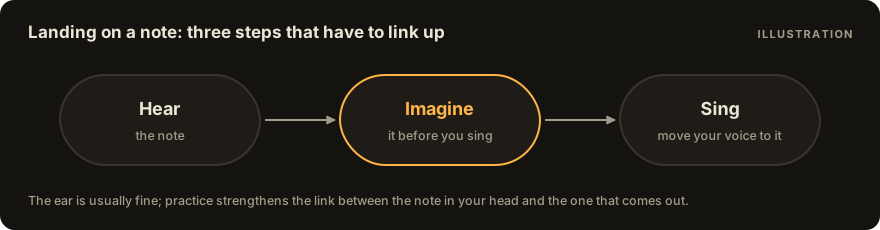
Landing on a note takes three things working together: hearing the note, imagining it before you sing, and moving your voice to it. Most of the time the ear is fine. What's missing is the link between the note you hear in your head and the one that comes out. That link gets stronger with short, regular practice, the same way any other movement does.
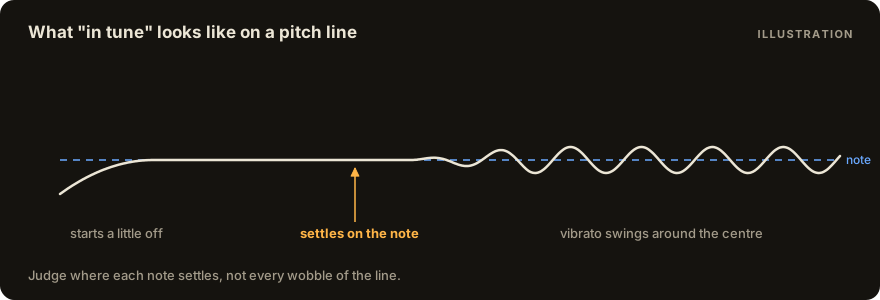
It also helps to know what "in tune" means in practice. Nobody sings a perfectly straight line. Good singers start a note a little off, settle into it, and add vibrato on long notes. What listeners hear as "in tune" is where each note settles, not every moment of it.
The routine (10 minutes, with any tuner or piano app)
You need a quiet room and something that plays or shows notes: a piano or keyboard app, or a free tuner app.
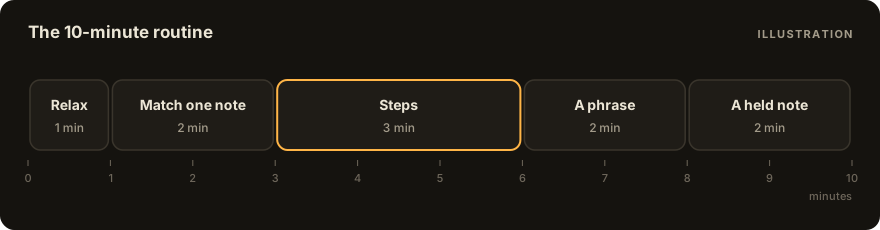
- 1 minute, relax. Sigh down from high to low a few times and loosen the jaw. A tight jaw and throat make every note harder to place.
- 2 minutes, match one note. Play a comfortable note, listen, hear it in your head, then hum it. Stay on it until your voice and the note blend into one sound. If you can't tell whether you're above or below, slide your hum slowly up and down until the two sounds lock together.
- 3 minutes, steps. Sing do-re-mi up and down five notes, slowly. Check the landing of each note, not the slide into it. If one step keeps landing flat or sharp, repeat just that step a few times.
- 2 minutes, a phrase you know. Sing a short phrase of a song, record it on your phone and listen back once. You hear yourself differently from outside, and one honest listen teaches more than five more takes.
- 2 minutes, a held note. Hold one note for 4 seconds and watch whether it drifts up or down. Many voices drift flat as the breath runs out. Notice where yours goes.
Keep it daily and keep it short. Ten focused minutes are worth more than an hour once a week, and stopping while it's still easy makes it more likely you'll come back tomorrow.
Reading a pitch app honestly
Pitch apps and tuners draw your voice as a line. That line moves far more than your ears do, and it's easy to read normal singing as mistakes.
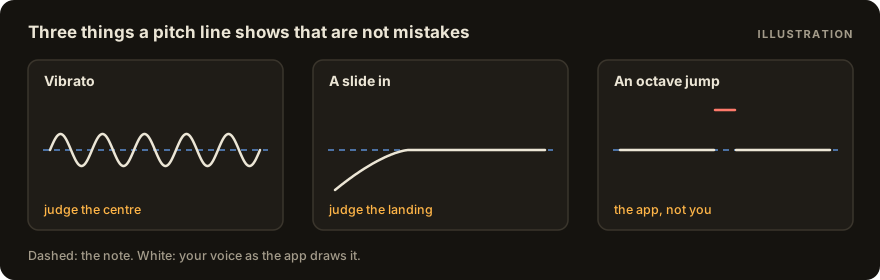
- Vibrato swings above and below the note several times a second. That isn't "out of tune": judge where the swing is centred.
- Slides into a note are style, not error. What counts is where you land.
- Octave jumps on the screen are usually the app hearing a harmonic, not you singing an octave off.
- Sing with headphones if the app plays a guide note, so the app hears you and not the speaker.
One more: the first moment of a note, and the breathy start of a phrase, are the hardest parts for any app to read. If the line jumps around there and then settles, trust where it settles.
When the routine gets easy
Make it a little harder, one change at a time:
- sing the steps without playing each note first, then check;
- move from steps to small jumps (do to mi, do to sol);
- sing along with a recording of a song, then without it, and check the same phrase;
- move the routine a little higher or lower than is comfortable, without pushing.
Echo Sing
We're building Echo Sing, a singing coach that follows these rules: it judges the centre of a note, and it treats vibrato and slides as singing, not mistakes. It isn't out yet.
Questions
Can anyone learn to sing in tune?
Most people can improve with practice. Hearing that two notes differ is usually already there; matching your voice to the note is the part that's trained.
How long should I practise each day?
A short routine every day works better than a long session now and then. The 10 minutes above is a good start.
Why does my tuner app say I'm out of tune when it sounds fine?
Often it's showing vibrato, a slide into the note, or a harmonic. Look at where each note settles, not at every movement of the line.
Do I need a piano to practise?
No. A free piano or tuner app on your phone is enough to play reference notes and check where you land.