
How do I add air to vocals on iPad without making them harsh?
Add the lift late in the chain, after EQ and compression, and use as little as opens the voice. The main risk is a fixed high shelf: it adds the same treble to quiet and loud lines, so the setting that opens a soft verse can make a loud chorus and its "s" sounds harsh. A lift that follows the voice avoids that. OneMove Air is a free AUv3 for iPad and iPhone that works this way. We make it, so weigh this accordingly.
Where to put it
- Clean and tune first. Lifting the top also lifts hiss and room noise.
- EQ and compress before it. A compressed voice has a steadier top end, so the lift stays even.
- Air near the end, before reverb and before a final limiter.
- De-ess before or after? If the "s" sounds already bite, de-ess before you add air. If they only bite after the lift, lower the lift in the 3–6 kHz range instead of adding a de-esser.
How much
Start with nothing and raise the lift until the voice sounds open in the mix, not on its own. Then compare with the effect off at the same loudness: a louder version always sounds better, so level-match before you decide.
Typical starting points with OneMove Air:
| material | preset | Air knob |
|---|---|---|
| lead vocal | Vocal Air | 30–40 % |
| breathy or dark vocal | Vocal Air | 40–55 % |
| bright or sibilant vocal | Vocal Air, Mid Air lowered | 20–30 % |
| backing vocals | Vocal Air | 35–50 %, with Mix at 60–80 % |
A fixed shelf or a lift that follows the voice?
| fixed high shelf | dynamic lift (OneMove Air) | |
|---|---|---|
| quiet, dull lines | lifted | lifted a lot |
| loud, bright lines and "s" sounds | lifted just as much | lifted only a little |
| pauses and breaths | lifted | not lifted below the Floor level |
| latency | usually none | none (reports 0 samples) |
A shelf is simpler and perfectly fine on a steady part. On a vocal that moves between soft and loud, a lift that backs off on bright moments keeps the top end more even.
Hear it
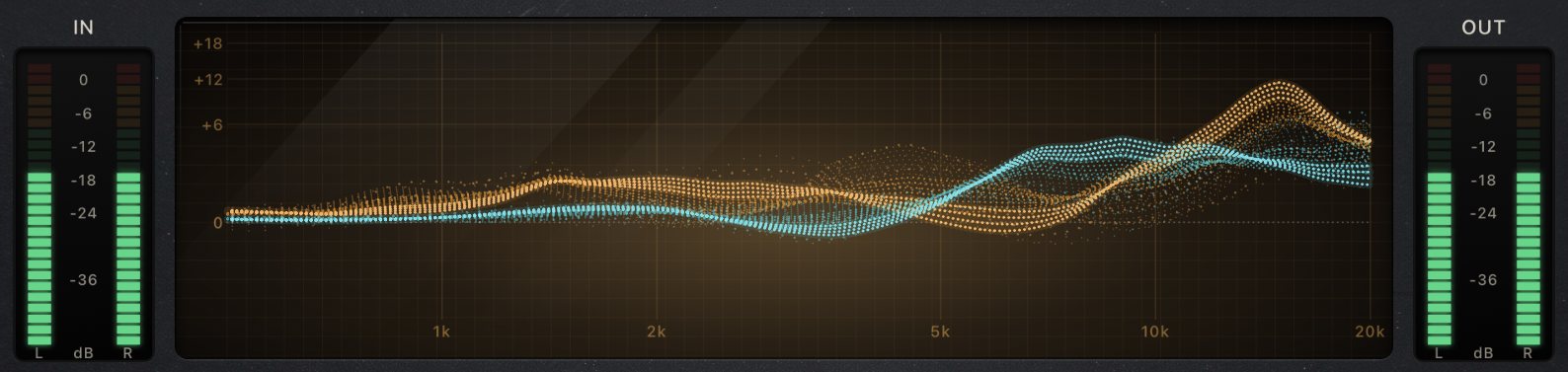
The app's demo vocal over its band. Air is on the vocal only, as it would be on a vocal track. The versions are matched in loudness.
Air on a vocal over music
The Try material from the app: Air on the vocal only, the music unprocessed. The Vocal Air preset (Air 35 %), then the Air knob at 60 %. Before and after are set to the same loudness, so you hear the change, not a level jump.
"Lost_Pella" by queeniemusic (ccmixter.org/files/queeniemusic/65508), licensed CC BY 3.0 (creativecommons.org/licenses/by/3.0). Excerpt, processed by OneMove Air. Music by OneMove Audio.
Questions
Is OneMove Air free?
Yes: no in-app purchases, no ads and no account. It runs as an AUv3 in any host on iPad and iPhone.
Does adding air add latency?
A plain EQ shelf usually adds none. OneMove Air also adds none: it reports zero latency to the host, so you can sing through it live.
Why does my vocal sound harsh after adding air?
Usually too much lift in the upper mids (3–6 kHz), or lift on lines that are already bright. Lower the amount, move the lift higher, or use a lift that backs off on bright moments.
Should I add air before or after reverb?
Before, in most cases. Air after a reverb also brightens the reverb tail, which can sound splashy.