
Tame: dynamic EQ and de-esser
Module 03 of 14 · Dynamic EQ and de-esser
- One Move knobTame
- Latency0 ms
- CPU, iPad Air M31.9 %
- Default position3 of 14, after Tune
Tame is a four-band dynamic EQ. It cuts mud, boxiness, harshness and sibilance only at the moments they stick out, and leaves the voice alone the rest of the time. One knob sets how firmly. It adds no latency.
Hear it
Tame: harsh and sibilant moments
Tame on its own (Strong De-ess preset, knob at 90): it only turns down the bands that jump out, when they jump out. Listen to the S sounds and the bright high notes. Before and after are set to the same loudness, so you hear the change, not a level jump.
"Lost_Pella" by queeniemusic (ccmixter.org/files/queeniemusic/65508), licensed CC BY 3.0 (creativecommons.org/licenses/by/3.0). Excerpt, processed by OneMove Vocal Console.
The One Move: Tame
The knob scales all four bands together. At 0 nothing is cut. Turning it up deepens each band's maximum cut toward its full range (Mud −4, Box −3, Harsh −5 and Ess −8 dB at the top) and makes the bands up to 4 dB more sensitive.
Tame sits before the compressors and the rider, so they react to a voice that is already calm.
Expert
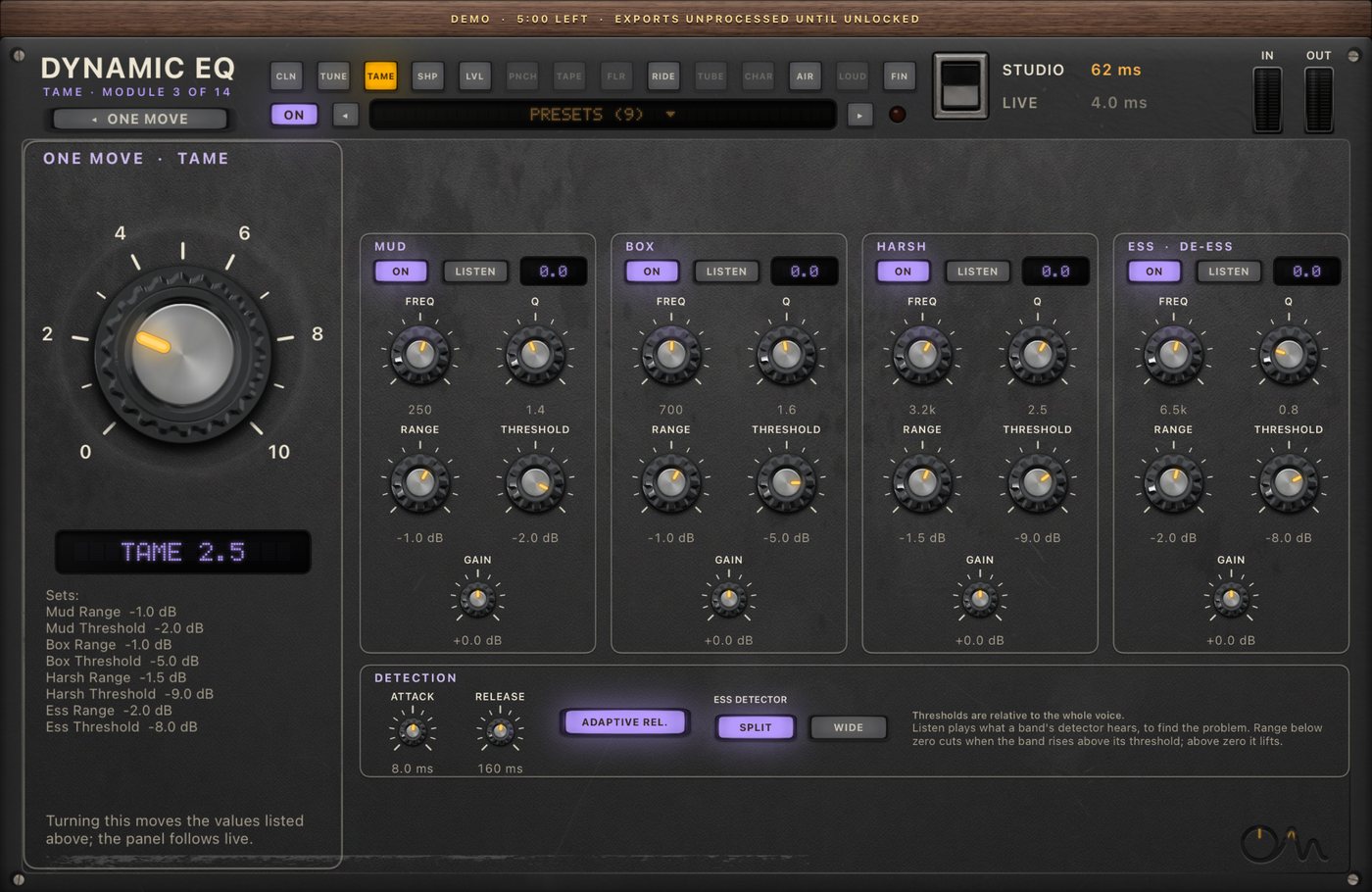
Four bands, each a bell or shelf whose gain follows its own detector:
| band | centre | job |
|---|---|---|
| Mud | 250 Hz | low-mid build-up, proximity effect |
| Box | 700 Hz | the hollow "cardboard" sound of small rooms |
| Harsh | 3.2 kHz | piercing peaks on loud notes |
| Ess | 6.5 kHz, high shelf | sibilance: s, sh, t |
| control | what it does |
|---|---|
| On, per band | switches the band |
| Listen, per band | plays what that band's detector hears, so you can find the problem |
| Freq, Q | where the band sits and how wide it is |
| Range | the most the band may cut (below 0) or lift (above 0), −12 to +6 dB |
| Threshold | the level, relative to the whole voice, where the band starts to work |
| Gain | a static boost or cut, ±12 dB |
| Attack, Release | 0.5–100 ms and 10–2000 ms; Adaptive Release lengthens release on sustained problems |
| Ess detection | Split or Wide |
Detection is relative. Each band reacts to how much louder it is than the whole voice, not to an absolute level. So one setting works for a quiet verse and a loud chorus, and a hot or quiet input doesn't change what it does.
Specs
| Latency | 0 ms: gains are recomputed every sample, with no look-ahead |
| CPU, iPad Air M3, only Tame on | 1.9 % of one core |
| Channels | mono and stereo |
| Sample rates | 44.1–96 kHz |
FAQ
Do I still need a separate de-esser?
Usually not. The Ess band is a de-esser: it reacts only when the 6.5 kHz region rises above the rest of the voice. Use Listen on the Ess band to hear what it catches, and raise its Range if the s sounds are still sharp.
What is the difference between Tame and Shape?
Shape is a static EQ: its cuts are always on. Tame is dynamic: it only cuts when a band jumps out. Use Shape for problems that are always there (rumble, a boomy room) and Tame for ones that come and go (a harsh high note, an s).