
Level and Punch: an opto leveller and a FET limiter, measured
Engineering note.
Two compressors have shaped more vocals than any others: the optical leveller of the Teletronix LA-2A family and the FET limiter of the UREI 1176 family. OneMove Vocal Console has one module modelled on each: Level (2A-style opto) and Punch (76-style FET). This note explains what those circuits do, what we modelled, and how close our versions measure.
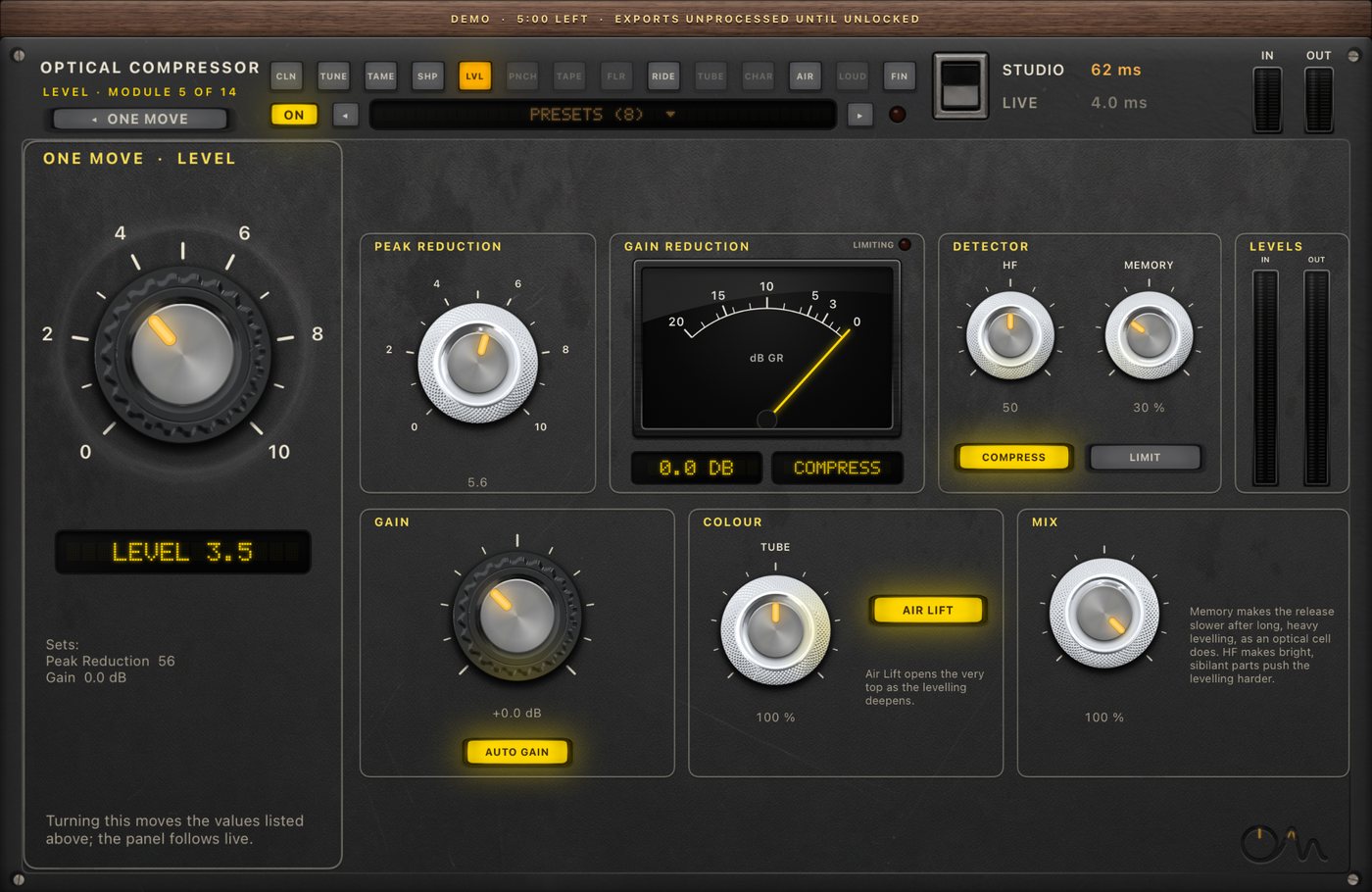
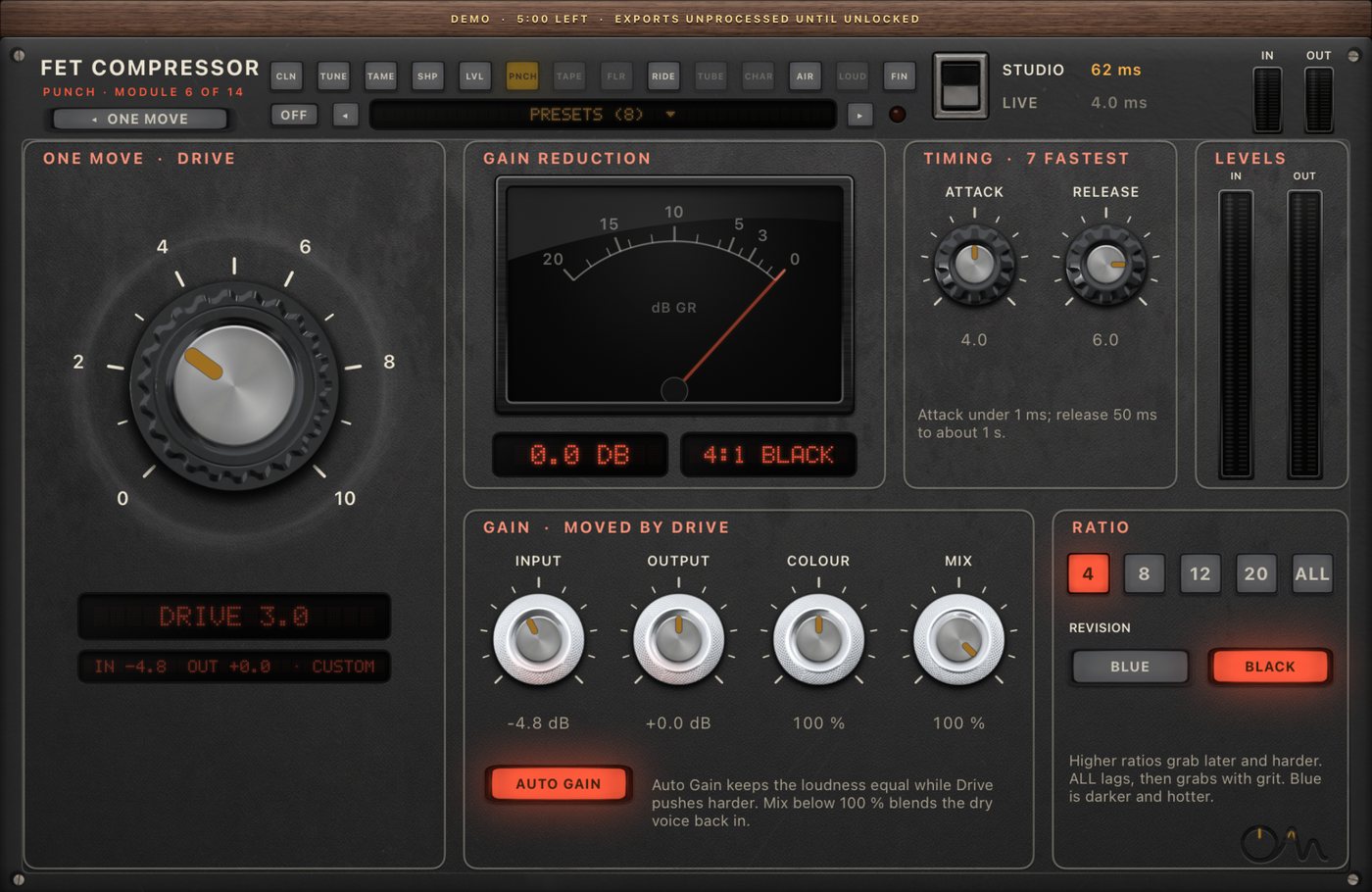
How we worked
- Read the circuits, not the code. We studied the units' published service manuals and the data sheets of their key parts (the optical cell, the FET), and wrote down in our own words what each stage does to the sound. We did not copy schematics, and no other company's code or data is in our product.
- Measure a reference. We measured a widely used software emulation of each unit from the outside: static curves with sine tones at every ratio, attack and release with level steps, harmonics at several levels, and frequency response.
- Fit our own model. Our modules are our own designs, written from the circuit analysis. Their constants were then fitted against those measurements until every curve landed inside a tolerance we set in advance.
The opto leveller (Level)
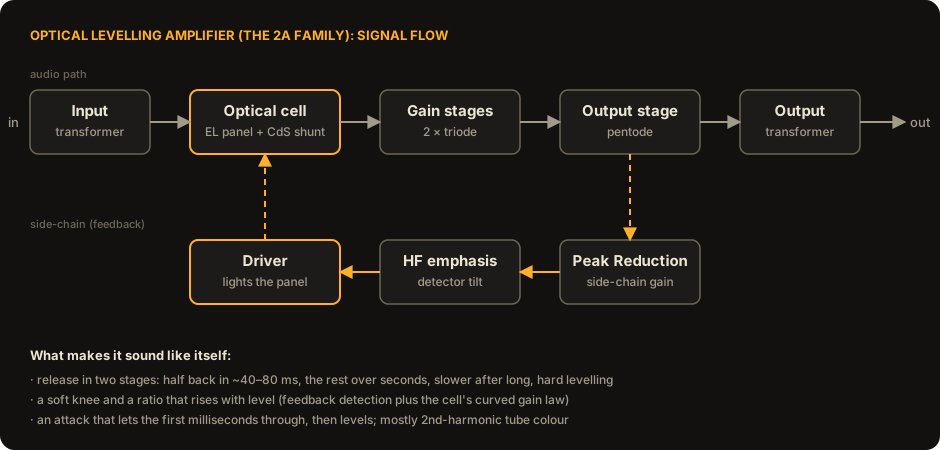
The whole character of an opto leveller lives in its optical cell: a light panel shining on a light-dependent resistor. The panel reacts in about a millisecond, but the resistor answers along a curve. That gives three behaviours we model directly:
- A two-stage release. About half of the gain comes back in tens of milliseconds, and the rest over seconds. Our release is built from a fast and a slow part, and the slow part lengthens after long, deep levelling (the cell's "memory").
- A soft knee with a rising ratio. There is no threshold control. Peak Reduction is the side-chain's gain, and the curve steepens gradually.
- A slow attack tail. The first milliseconds of a word get through, then the voice is levelled.
On top of that sit a detector treble tilt (the HF control), Compress and Limit, and an even-harmonic valve colour. One deliberate difference: in Limit mode the reference detects mostly from its output. Ours detects from the input in both modes, because that fitted the measured curves better.
The FET limiter (Punch)
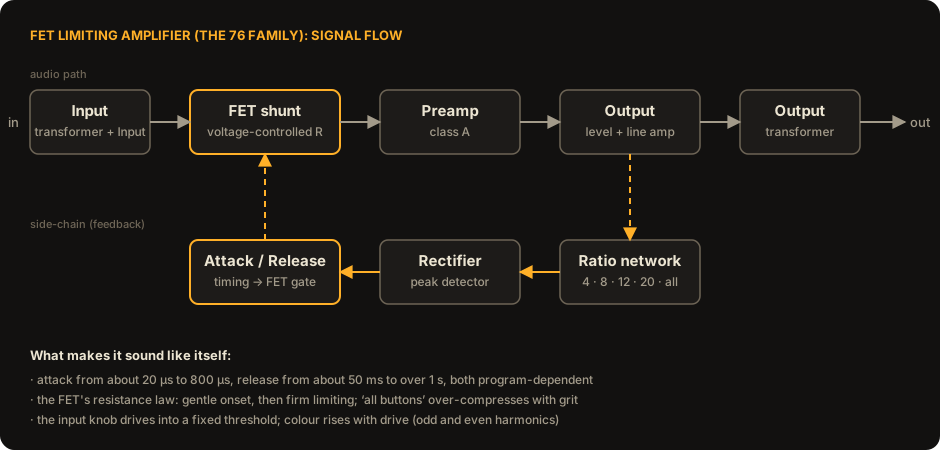
A FET limiter uses a field-effect transistor as a voltage-controlled resistor, fed back from the output. Its signatures:
- Very fast, program-dependent timing. Attack from tens of microseconds, release from about 50 ms to over a second. Ours runs three detector branches (fast, medium and slow) whose weights and time constants were fitted to the measured step responses at the slowest, middle and fastest knob settings.
- The FET's resistance law. Onset is gentle, then the limiting is firm. "All buttons" mode over-compresses and adds grit.
- Drive, not threshold. The input knob pushes the voice into a fixed threshold, and the colour rises with it. The two revisions differ in tone and timing: the darker "blue" and the cleaner "black".
How close it measures
These are static curves for 1 kHz sine tones from −40 to 0 dBFS. The figure is the RMS difference from the reference's gain reduction across the whole sweep.
| timing | ours | reference |
|---|---|---|
| Punch release, half recovery: slowest / middle / fastest | 1135 / 480 / 40 ms | ≈ 1100 / 500 / 50 ms |
| Level release, half recovery | 160 ms | 170 ms |
| Level, gain reduction still left 1.5 s after release | −1.0 dB | −0.7 dB |
Not modelled: mains hum and valve noise, which the hardware has and a vocal chain doesn't need. Transformer behaviour at very low frequencies is simplified.
Why it matters on an iPad
Both modules add no latency (there is no look-ahead). With either one switched on alone, the whole plug-in runs at about 1.3 % of one core on an iPad Air M3. A complete vocal chain with both compressors runs at about 6 % of one core. The method and raw report are on CPU on iPad.
Teletronix, LA-2A, UREI and 1176 are trademarks of Universal Audio, Inc. They are named here only to identify the historical designs we studied. OneMove is not affiliated with, endorsed by or connected to Universal Audio or any maker of the products mentioned. "2A-style" and "76-style" describe circuit behaviour.