
Tube: valve harmonics
Module 10 of 14 · Tube saturation
- One Move knobTube
- Latency0 ms
- CPU, iPad Air M31.2 %
- Default position10 of 14, after Ride
Tube adds even-order harmonics, the warm thickness of a valve stage, without changing the level. One knob sets how hard the valve is driven.
Hear it
Tube: driven
Tube on its own (Driven Hard preset, knob at 100): strong valve-style drive on a male vocal. Before and after are set to the same loudness, so you hear the change, not a level jump.
"More Than 2 Sides (accapella)" by Colin Mutchler (ccmixter.org/files/commonsplice/2599), licensed CC BY 2.5 (creativecommons.org/licenses/by/2.5). Excerpt, processed by OneMove Vocal Console.
The One Move: Tube
The knob sets the drive from 0 to 10, and the sag grows with it. The output stays level-matched.
Expert
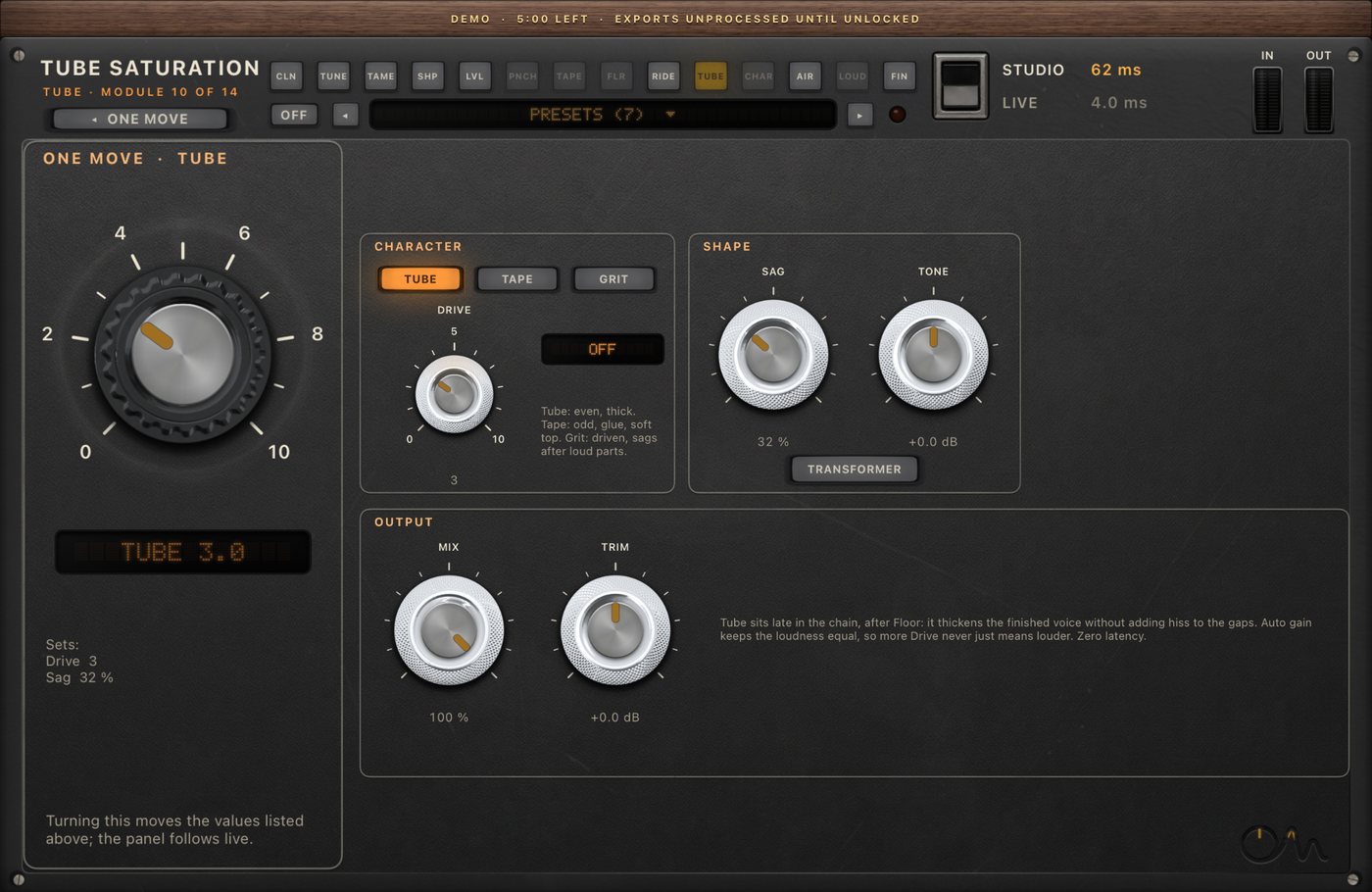
Tube shares its engine with Tape. It starts on the Tube character with its transformer off.
| control | what it does |
|---|---|
| Drive | 0–10: how hard the valve is pushed |
| Character | Tube (even, thick), Tape (odd, glue, soft top) or Grit (driven, sags after loud parts) |
| Tone | ±6 dB tilt of the saturated sound |
| Sag | compression of the saturation after loud passages |
| Transformer | low-frequency weight and harmonics |
| Mix | blends the dry voice back in |
| Trim | output level, ±12 dB |
Specs
| Latency | 0 ms |
| CPU, iPad Air M3, only Tube on | 1.2 % of one core |
| Level | matched to the input |
FAQ
Why are there two saturation modules?
They do different jobs in different places. Tape, after the compressors, glues and softens peaks. Tube, later in the chain, adds thickness to the levelled, ridden voice. Use one, both or neither.
Will Tube make my vocal distort?
At low settings you hear warmth, not distortion. The Grit character and high drive are there for when you want it to break up.