
How we rebuilt Tune against a measured contract
Pitch correction is easy to describe and hard to get right. It has to pick the right note, move there at the right speed, leave vibrato and scoops alone when they are part of the performance, and do it without clicks or a rough, wobbly voice. For OneMove Vocal Console's Tune module we wrote all of that down as a contract: a list of measurable checks with pass/fail limits. Then we rebuilt Tune until it passed.
The short answer
| check (test signal, 48 kHz) | Tune, Studio | Tune, Live | reference tuner |
|---|---|---|---|
| Hard setting: settles on a note from silence | 15 ms | 28 ms | 13 ms (high quality) / 31 ms (live) |
| Hard setting: note-to-note change | 35 ms | 46 ms | 30 ms / 33 ms |
| Steady pitch error on held notes | 0.1 cent | 0.1 cent | |
| Natural setting: vibrato kept (50–100 cents deep) | 80–96 %, never exaggerated | ||
| Live engine splices on real voices | 1.9–2.5 per second | ||
| CPU, iPad Air M3, Tune alone in Live mode | 0.93 % of one core |
The reference tuner's note changes are still a little faster than ours. We say so here and on our comparison page.
Hear it
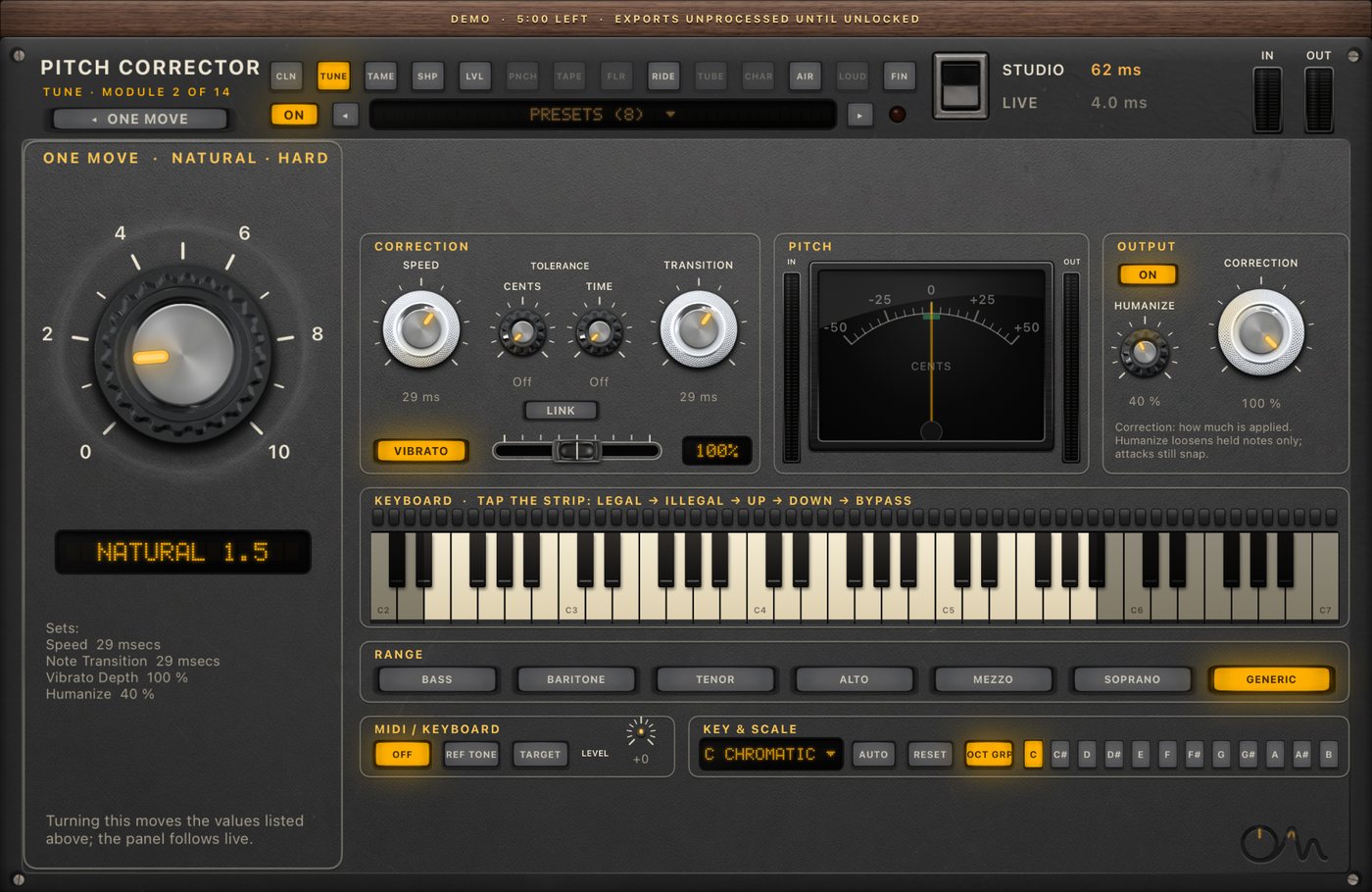
Tune: Natural and Hard
Dry, then Tune on Natural (keeps the vibrato), then Hard Snap (the instant, stepped effect). Before and after are set to the same loudness, so you hear the change, not a level jump.
"Lost_Pella" by queeniemusic (ccmixter.org/files/queeniemusic/65508), licensed CC BY 3.0 (creativecommons.org/licenses/by/3.0). Excerpt, processed by OneMove Vocal Console.
Why a contract
Listening tests alone don't tell you why a tuner sounds rough, and a single number such as "speed" hides most of what matters. So we split the job into behaviours that can each be measured from the audio alone:
- Which note: the nearest note in the key and scale, with the switch point halfway between neighbouring notes.
- When it acts: the first 20–30 ms of an onset pass as sung, then the correction reaches the target within the set speed.
- What it leaves alone: vibrato is never amplified at any setting, scoops survive, breaths and sibilants keep their level and pitch.
- How clean it is: no added frame-to-frame wobble, no octave jumps, no dropouts or clicks.
How we measured
We measured from the outside only: audio in, audio out. As a reference point we ran a widely used commercial pitch corrector, Antares Auto-Tune Advanced, offline on the same inputs. No code or data of that product is used in ours.
Inputs
- A known-pitch test signal (51 s): sung-like notes from silence and legato, vibrato at 25, 50 and 100 cents and 4–7 Hz, a slow glide, scoops into notes, and a low note.
- Decision probes: a slow sweep across a note boundary, notes hovering at +45 to +55 cents, vibrato across a boundary, sharp breathy attacks, sibilants and breaths, quiet notes down to −55 dBFS, big leaps, and re-entries after short gaps. A second file repeats the sweep in C major, to check that notes outside the scale are never output.
- Two real a cappella takes, one male and one female, decoded to 48 kHz mono.
Measures
- Settle: time until the pitch stays within 10 cents of the target for 100 ms.
- Vibrato kept: the fitted output depth as a share of the input depth.
- Wobble: extra frame-to-frame pitch jitter over the dry take, in cents.
- Crops and boosts: 20 ms windows more than 4 dB below or above the dry take.
- Clicks: spikes in the prediction residual, compared with the dry take.
What we found in the old Tune
The first measurement was humbling:
- The live engine made the voice rough. It added 75–140 cents of frame-to-frame jitter and three to four times more octave jumps than the dry take, even at the natural setting where almost no correction is applied.
- The natural setting barely corrected. Note changes took 260–350 ms.
- A mid setting exaggerated vibrato to 150–180 % of the sung depth: the correction overshot and rang at vibrato rates.
- Studio dropped level in 13–33 short windows per take.
What we changed
- A vibrato detector replaced a slow note-centre filter. The old filter lagged note changes by 150–300 ms and fed vibrato back into the correction. Now three turning points in a row with vibrato-like timing and depth mean vibrato: Tune aims at their midpoint and the vibrato passes untouched, or scaled by Depth.
- A new shifting engine. Both modes now resample between splices aligned to the voice's own period, instead of adding up one-period grains. The grains had passed the detector's reading noise straight into the output pitch.
- Live stays corrected through short gaps in the pitch readings instead of dropping to the dry voice several times a second, and 8 cents of hysteresis stop a voice that sits on a note boundary from flipping between targets.
- Fewer splices. The live engine now jumps half a period above its floor, which cut splices on real voices from 40–100 a second to 1.9–2.5.
- A faster detector. The pitch detector now compares the newest part of its window, which gives a first usable reading after 15.5 ms (median, real recordings) instead of 28.6 ms. See the pitch detector benchmark.
Results on the real takes
After the rebuild (7 November 2026), on the same two takes:
| before | after | reference tuner | |
|---|---|---|---|
| Live wobble added, male / female take | +73…80 / +110…138 cents | +9…28 / +6…27 cents | +7…33 / −2…+37 cents |
| Studio level crops per take, male / female | 13–21 / 30–33 | 2–5 / 2 | 0–9 / 5–9 |
| Vibrato kept at mid settings (50–100 cents) | up to 179 % | 84–98 % | |
| Male scoop at the hard setting | an octave off | kept | kept |
| Re-entry after a gap (Studio) | up to 40 cents sharper than sung | starts from the sung pitch | starts from the sung pitch |
The detector work then brought the hard setting's settle time down to the figures at the top of this page.
What is still open
- Note changes inside a phrase are 5–13 ms slower than the reference at the hard setting.
- Light vibrato (about 25 cents) is not always recognised, and is partly flattened above the natural setting.
- Octave decisions: the neural pitch trackers we tested make fewer octave errors than any classic detector. A small on-device "octave judge" is the next experiment.
Reproducing it
The test signal, the probes and the scoring scripts are part of our research harness. We publish the method here so the numbers can be checked; if you build your own tuner, the contract table above is a good place to start.
Auto-Tune and Antares are trademarks of Antares Audio Technologies. The product is named only to identify the reference we measured against. OneMove is not affiliated with or endorsed by Antares. Measurements made 6–8 November 2026.